Denise Dutton with the rough plaster line Maquette
Following months of discussion, research and painstaking work in miniature, our wonderful sculptor Denise Dutton has completed the rough plaster line maquette of Mary. She is now in the process of preparing a resin copy and a mould for the final bronze.
Denise has faced many challenges. She has had to work from only 5 photographs, some of which are of poor quality and none of which depict Mary’s whole body. In addition to that, we set her the difficult task of depicting someone who was both frail and self-effacing, but at the same time, strong and formidably brave, a shy leader, a ‘martyr’ with a wry sense of humour.
We asked Denise to tell the story of Mary’s life and death, expressing her gentle dignity and calm strength as well as her courage and determination. The agreed design depicts Mary after leaving prison, two days before her death. She gestures towards a lamp at her feet which she has left for others to pick up. Her hand is held low, so that children can hold it and pose for photographs (we suspect many will want to rub the lamp and make wishes). The lamp references the statement by Isabella McKeown, made at Mary’s memorial meeting in the Royal Pavilion. She said “Her they must not mourn in silence. They must take the torch from her and light the darkness…”
Mary wears a suffragette sash and on her left arm carries a last few copies of Votes for Women, the suffragette newspaper she regularly sold in Brighton. The front page of the November 1910 issue depicts the events of ‘Black Friday’, 18th November 1910, when she, like so many other women was injured by police violence. Mary was deeply distressed at the suffering of women that day, many of whom were subjected to sexual abuse.
Mary wears the Hunger Strikers’ medal and walks across the implements used in forcible feeding, which she ignores and which are imbedded in the surface of the plinth. Her clothing, accurate for the period, subtly references Mary’s background as an artist, her love of flowers and her time in prison. The pattern on the skirt includes the ‘prison arrow’ which was used on convicts’ clothes and was carried with pride on suffragette banners.
The low plinth carries Mary’s words “I am glad to pay the price for freedom..”, with the above quotation from Isabella McKeown, as well as Emmeline Pethick-Lawrence’s statement that Mary was the “first woman martyr who has gone to death for this cause.”Just days after Mary’s death, her grief-stricken sister Emmeline Pankhurst wrote: “She is the first to die. How many must follow…”. Those words will be on the surface of the plinth, curving around the line of the feeding tube embedded in the bronze, bringing the two sisters together.
We are very grateful to local magazines The Post, Preston Pages and 7Directory. They have not only featured long articles about Mary and the Appeal, but have also made the campaign their cover story, using wonderful images of Mary and publicising the fact that the design and rough maquette (model) of the statue-to-be are now complete.
We are especially grateful for the Editorial which read: “We are so proud to have the history article about Mary Clarke this month and want to thank Jean Calder and the whole team for their work to recognise and record this brave woman properly. It would be especially wonderful if the statue were erected by public subscription – a genuine expression of our pride in a hitherto unknown local heroine”.
Supporters living in Brighton & Hove will have noticed that, post lock-down, many of the city’s free community magazines have re-appeared and combined. Sussex Magazines has gathered several titles into two new umbrella publications – The Brightonian and The Hovarian. We are so proud that in their inaugural July editions they chose to feature articles about the Mary Clarke Statue Appeal.Please support these worthy new publications which will continue to be delivered to homes, left at key venues and made available online. The September editions are now out. https://issuu.com/sussexmagazines/docs/the_brightonian_july_2020__issuu/44 https://issuu.com/sussexmagazines/docs/the_hovarian_july_2020_issuu/44
Our sculptor Denise Dutton is hard at work on the maquette, doing the delicate work on facial features – a challenging task, given we have so few photographs and many of those we do have are of poor quality.
Denise Dutton at work on the maquette
One of Mary’s most endearing qualities was her lack of egoism and consequent quiet refusal to promote herself. However, this is causing real difficulties for those wishing to commemorate her.
Denise has sent us a photograph of herself with the maquette. She is wearing a headset with magnifying lenses in it to assist the modelling of fine detail. She says “As you may notice at present she has no hair, or hat, and I’ve removed her arms to enable easier access to model the portrait and skirt.”
We look forward to seeing more and will keep supporters updated.
Terri Bell Halliwell spear heads a national Brighton-based campaign to get more statues for women. She has been an inspiration to use and a consistent supporter from the start. She writes as follows:
“Mary Clarke is one of the great band of wonderfulwomen who have been ignored by the powers that select those suitable for public commemoration. Civic statues in the UK – and worldwide – are so heavily biased in favour of men that any woman, no matter how significant, is unlikely to enter into consideration, let alone achieve selection. At the last count 85% of UK civic statues were of men and, of the remaining 15%, most were angels, nymphs or allegorical figures; maternal, saintly or sexualised. The vanishingly few real, named women honoured for their achievements, amounted to less than 3%. That’s 3% to stand for 50% of the population. One cannot help but wonder how this gross inequality arose?
Given that statues have been erected since earliest history we must assume that they have value to those who put them up. They require both finance and power over the use of public sites, so the ability to erect them has fallen almost exclusively to the ruling political or regal powers. In short, in a patriarchy, it has been a choice in the hands of men. The statistical evidence tells us they have chosen to mirror their own great deeds and their own agendas, wilfully overlooking the great deeds, achievements and contributions of women.
A civic statue has a quiet persistent power, that retains influence over decades, even centuries. We have only to consider the current rightful protests about the civic glorification of abhorrent slave owners for evidence of that power and its real ongoing effects.
Now is the time for us all to re-consider exactly who it is that we choose to honour in our towns and cities, to ask who it is that we want to see immortalised and passed down to future generations to stand as symbols of what we truly value.
Who are our heroes now? More to the point, who are our heroines? Surely, Mary Clarke is one of those heroines, of whom Brighton can be justly proud.”
Jenny Engledow is well known in Brighton as a human rights and peace campaigner. What is less well known is that she is an excellent seamstress and embroiderer and has made beautiful banners for a range of causes. Many local people will have seen the beautiful banner Jenny made to celebrate the 2018 Centenary of women’s partial achievement of the Vote. It was based on a contemporary design prepared for the Brighton Branch of the WSPU. Now she has agreed to make a banner for Mary Clarke. The design is her own, based upon contemporary photographs, but the style echoes the beautiful ‘pennant’ banners carried in procession by the suffragettes. They were designed to represent various women’s crafts and professions, but there were also individual banners to honour individual women of note. A huge amount of work has gone into the banner and despite COVID-related problems in supply of embroidery materials, Jenny is forging ahead. We thought you might like to see her at work. We are so grateful to her for this wonderful gift of her time and creativity. Once completed, the banner will be placed on public display and also taken out on procession. Our hope is that eventually, on key dates such as International Women’s Day or Human Rights Day (which is just before Mary’s birthday) the people of the city will be able to process to the statue with this and other banners.
On Tuesday 23rd June 2020, on a lovely sunny day as lock-down was just beginning to ease, the new Mayor of Brighton & Hove, Councillor Alan Robins, in full mayoral robes, visited us at the Royal Pavilion Gardens near the entrance to the Museum. He was there to show his support for the proposed statue for Mary Clarke and was accompanied by the Mayoral Consort Val Cawley.We have the all-party support of the City Council, but we are particularly grateful to Cllr Robins, the former Chair of the Tourism, Development and Culture Committee, who has backed this initiative from the start.
The Pavilion Estate has deep historic ties with the suffrage movement. In 2018 the Dome was declared a site of National Suffrage Interest by Historic England, because so many meetings had taken place there. We know that Mary herself chaired and spoke at a large meeting there in May 1910, seven months before she died. However, we also know that suffrage meetings took place in the Pavilion itself and in the tea rooms adjacent to the Pavilion (almost certainly on the site of the present Pavilion shop). Mary’s memorial service in January 2011 was held in the Pavilion. At least one suffrage meeting took place in the Chapel Royal and we have been informed (though we do not yet have written evidence) that fundraising teas took place in the Gardens.
Our aim is to place Mary’s statue in the Gardens, as close as possible to the entrance to Brighton Museum, where it can be linked to educational displays in the Museum. We hope that every school child, adult resident and visitor will see and recognise the statue as a symbol of the city’s ongoing commitment to democracy, equality and women’s rights.
Introductory Note from Jean Calder
Mary Clarke (date unknown)
This was the text of the Oration delivered at Mary Clarke’s Memorial meeting in Brighton. It is a heart-rending speech, made by Emmeline Pethick Lawrence, a woman who knew Mary well and who, with Emmeline Pankhurst, was one of the outstanding leaders of the suffrage movement. It identifies Mary as an influential and well-loved leader of the movement, while conveying anger, grief and huge respect for Mary’s contribution. It gives a real sense of Mary’s warmth and gentleness as well as her formidable bravery. Grateful thanks to our Patrons June Purvis and Elizabeth Crawford for sending copies of the Obituary in a legible form (Votes for Women on line is not easy to read!). I’ve retyped it, so any errors are mine.
The Utmost for the Highest
A Memoir By Emmeline Pethick-Lawrence
“Greater love hath no man than this, that a man lay down his life for his friend.” Mary Clarke laid down her life for the most deeply wronged, the most cruelly bound of all the human race. She died for those women numbered in this land of ours, and in all lands of the Earth, by the thousand thousand; women to whom death would be merciful, so cruelly used have they been by man and by man-made law. These defenceless and voiceless ones were“her friends”. Because of the great compassion for them that was in her heart she faced ridicule, blows, brutal usage by roughs, the handling of the police, and three imprisonments. For them she paid (to use her own words) “the price of freedom”. Glad to pay it – glad though it brought her to her death.
Mary at a Welcome meeting for released prisoners in early 1908. Mary is on the left beneath the clock.
I vividly remember seeing her suddenly in prison. She had gone with two or three others to knock at Mr Asquith’s door. Some weeks later I was myself arrested for attempting to take a petition to the House of Commons, and went for two months to Holloway Gaol. On the first morning I hearda low voice speaking my name. I turned round, and it was some seconds before I recognised her in the disfiguring criminal garb. It seemed to me especially shocking to see that frail, refined, sensitive woman, clad in so coarse and grotesque a way, “numbered” amongst the depraved, for, of course, she was wearing the prison badge. Her face wore that look of extreme patience and extreme gentleness which was it’s habitual expression in repose. In that dreary place of despairing souls she seemed indeed a “Prisoner of Hope”.
It was her second imprisonment. The first time she had been arrested as a member of the deputation that sought to interview the Prime Minister in the “People’s House“. For the third and last time she endured that experience which, as she expressed it in her speech two days before she passed from us, stamped fast and indelible the “purple, white and green” upon the soul of every woman who went through it. She referred to herself as dyed, double-dyed and thrice dyed a suffragette by the baptism of imprisonment.
Beside that vision of Mrs Clark in prison I have another specially clear remembrance of her. This was at the first informal meeting of the WSPU in London, February, 1906, when we originally formed a London committee. Mrs Pankhurst was there, Mrs Drummond, Sylvia Pankhurst, Annie Kenney, Mrs Clarke and one or two others beside myself. From that little meeting the entire Movement in London and the entire National Movement sprang and developed. During all those years Mrs Clarke has been identified with it.
Mary on release from prison. She can hardly be seen, second from the left at the back.
She was naturally so quiet, so shrinking that, when the way cleared for her to devote her whole time to the work and when the post of Organiser was offered to her, she could not believe that she would be able to fulfil the onerous duties of leadership. She quickly became a remarkably successful organiser, winning the love and confidence of members wherever she went, inspiring courage and devoted service, dominating the rough elements that are always found in election crowds, quelling the brutality of Liberals of a baser sort, roused to fury by party fanaticism as they realised the damage done to their side by her lucid argument and persuasive speech.
In that frail and delicate woman’s body there was an indomitable spirit and courage past belief. No stress of weather, no intimidation or actual violence could deter her. She would hold at election times and at other busy seasons, three or four open-air meetings a day, day after day, standing in the rain so long as people would listen. A Brighton member writes that once a mob of young men surrounded her and refused to let her past. She reasoned with them at first, but when she saw they were determined to detain her she began to read her paper Votes For Women as if she had been in a drawing room. Seeing her so indifferent and unperturbed the youths got tired of this noble sport of woman-baiting, in which they have been so conspicuously encouraged by those in high places, and slunk away in small groups.
She was on several occasions very much knocked about, and some of her young workers were inclined to strike out in her defence, but she always restrained them. A Brighton member writes:“Once some roughs tried to pull me off the van by my coat, and I wanted the whip to hit them off, but she would not let me have it, offering to change places with me. Of course I refused.“
We don’t know exactly when this banner was made, but Mary may well have carried it.
We extract from an appreciative article in the Sussex Daily News a testimony to her habitual sweetness of temper: “Her ability as a speaker is well known by the hundreds who have listened to her earnest addresses on the Front, for she was the most indefatigable organiser of the Brighton Branch of the WSPU. Of heckling Mrs Clarke could stand a great deal. Though jeered at, mocked and ridiculed, her face wore always a sweet smile, and she was quite ready and willing to answer any reasonable questions put to her.”“She realised one’s ideal of courage and gentleness,“ writes one of her workers.
Mrs Clarke was greatly distressed by the terrible scenes she witnessed on Black Friday. She could stand ill usage herself, but could not bear to see others victimised. The tears were streaming from her eyes as she watched the women flung like footballs between the police in uniform and the organised mob of roughs led on by plainclothes offices of the force. She determined there and then to take part in any further action that might be necessary. But she became ill on her return to Brighton, and was obliged to keep her bed all the following Sunday and Monday. Her membersimplored her not to come up on the Tuesday. At last she promised one who loved her with great and special tenderness that she would not run the risk of being knocked about, but would choose another method of making a protest against the way the deputation had been treated. When she heard that the Tuesday deputation had been arrested she said, “Prison is the only place for self respecting women”. She calmly put a stone through the window of the police-station, saying to the constable who arrested her, “I voted that the deputation should go, and am morally as responsible as they are. If they are guilty of wrongdoing so am I, and I mean to share their punishment.“ She wrote to the friend who had implored her not to expose herself to violence, “I had to protest somehow; you would not have me a shirker.“ When her sentence was pronounced she telegraphed to her Brighton members, “One month. I am glad to pay the price for freedom“. In her letter to them from prison she said, “At 9 o’clock every night I shall be singing ‘To Freedom’s Cause Till Death’.”
The price has been paid – paid to the full. Mrs Clarke is the first woman-martyr who has gone to death for this cause. And quickly upon her footsteps has followed Henria Williams, another victim of Black Friday. How many more lives must be laid down, how many more of the best and noblest of the daughters of the people will be sacrificed before an elementary act of justice and reparation is done to the womanhood of the country? There will be no holding back of the women of this Union. Inspired by the example of our “saints“ there will be an eager desire to press forward, cost what it may. One letter is typical of the general feeling that animates the Union: “Somewhere I’ve read that ‘we mourn best when we do what the dead desire.’ I wish to go on the next deputation.“
“The last thing we did“ writes one of her fellow prisoners released earlier, “when we left Hollowaywas to call up ‘Good luck and goodbye’ to her window. She has had good luck, for death has honoured her.“ “I grieve with you,“ says another member of the last deputation. “I would that a worn out brush like myself might have paid the price.“ “Her work is by no means done.“ Another writes, “By her example many others will try to follow in her footsteps.“ Again and again recurs inthe letters received at headquarters the acknowledgement “We realise that she literally laid down her life.” From Ireland comes a letter from one who was released with Mrs Clarke: “In ancient Ireland the monument to the beloved and respected dead was made by the friends bringing one stone each to the mound, and the size of the accumulated pile showed the number of the friends. Truly, did ancient custom prevail amongst us, her cairn would rise like unto one of those hills single “‘from which come as our strength’.“
A working girl sends a verse from (“Poems by the Way”) William Morris:
“Here lies the sign that we should break our prison, Amid the storm she won a prisoner’s rest, While in the cloudy dawn the sun arisen Gives us our day of work to win the best.”
On the day of her release from Holloway Prison she spoke, with eyes shining with happiness, of her joy in the welcome given to her and those with her, adding, “If only it were not for the thought of those we have left behind!“
I remembered those words as I stood with the mourners at her grave side. Again she had found the joy of release. She had passed now and for ever out of the human power of those who hate Justice and keep Liberty in chains. Was the joy of her free spirit touched with sorrow for us whom she had “left behind“?
We may be sure that those whom she left in prison, who are still in prison and will be for many days to come, have no thought of pity for themselves. They have their work to do “to win the best“.
That thought is our inspiration also. Writing from prison to a girl whose youth prevented her from taking part in militant work, she said: “I wish you would hold a meeting on the Front as my deputy. Never mind about being too young. Tell them that while the old are in jail the young ones must do their work.“ The spirit of that instruction is the spirit of Mrs Clarke‘s message to young and old in this Union. Those who have held aloof hitherto or have refused the ultimate sacrifice must come forward now as her “deputy“.
Upon her last resting-place lies a laurel wreath, and upon it is inscribed those words which she telegraphed from the police court: “ I am glad to pay the price of freedom.“ This was sent as a tribute from the Brighton members. Upon a wreath of lilies and palms sent by the members of the Headquarters Committee, were the lines:
“The Spring will come, though we must pass Who gave the promise of its birth.“
There was no singing at the grave side, for owing to the breakup of the holidays the funeral was private, and but few were able to be present.
I would that we could have sung our marching song:
To Freedom’s Cause till death We swear our fealty, March on, march on! Face to the Dawn, The Dawn of Liberty.
Also the one and only hymn adequate to the occasion –the Church’s victory song:
Oh blest Communion! Fellowship Divine, We feebly struggle, they in glory shine, Yet all or one in Thee, for all are Thine, Alleluia!
Coronavirus
Covid 19 has driven a coach and horses through many of our plans. We can at least be thankful that, unlike many other charities, we are not delivering a service to vulnerable people which could be put at risk by the pandemic.
We were fortunate to have been able to hold our successful concert on 4th March and to have been able to celebrate International Women’s Day at the Dome. But our exhibition at the Jubilee Library, planned for the end of March, had to be cancelled.
Our sculptor Denise Dutton lives at some distance from her studio in Staffordshire. Travel to her studio is not essential, therefore production of the maquette, which was continuing apace, will surely now be delayed. We must all focus on protecting ourselves and others and of course the NHS.
We send our very best wishes to all our supporters, especially those who have been ill or whose vulnerability means they are unable to leave their homes at all. We send out condolences to any who may have lost loved ones.
In particular, we send out very best wishes to our Patron Maria Caulfield M.P.. Maria is a nurse and was one of the first politicians to offer her services to deal with the crisis. Stay safe, Maria. Thank you for all you are doing.
Another Patron in the News
Our Patron Peter Kyle M.P. has been in the news. He has been appointed by Sir Kier Starmer, Labour’s new leader, as Shadow Minister for Victims and Youth Justice. We send him many congratulations. We hope he may find an opportunity to mention Mary Clarke in Parliament as a symbol of women’s (and men’s) struggle for justice. She was, after all, a probable victim of domestic abuse and state violence, as well as of unjust imprisonment. Every good wish for the future, Peter.
Fundraising Jazz Concert a Great Success
On 4th March, internationally-acclaimed jazz singers Claire Martin and Liane Carroll gave their much-anticipated concert at St George’s Church in aid of the Appeal. The concert was hosted in sparkling style by comedian Zoe Lyons and the hugely effective appeal for donations was made by broadcaster Simon Fanshawe, one of our Patrons. After all expenses had been met, the event raised £4,500. Cllr Alex Phillips, Mayor of Brighton & Hove, was there, as were many councillors. Juliet Smith, Deputy Lieutenant for East Sussex was present, and introduced the evening in her capacity as one of the charity’s Patrons. Jazz fans and others who knew little about jazz, packed the church to hear the two singers present “Double Standards – an evening of jazz and joy”. There were numbers by Waits, Mitchell and Bennett skilfully mixed with lesser known classics. At times the audience sat in rapt silence, stunned by the talent of the singers and at others, they cheered, whooped and sang along. Claire Martin’s extraordinary rendition of A Natural Woman had most of the audience singing. Claire Martin and Liane Carroll were supported by local a cappella group Women of Note and feminist punk band Siren. Siren gave an upbeat first public performance of their moving Song for Mary, especially written by Jude Winter in support of the Mary Clarke Statue Appeal.
Women of Note’s rendition of Nana Was a Suffragette was a revelation to many of the audience, who had never heard it before. The event was organised by the Mary Clarke Statue Appeal, but with the support of many, many others. Jean Calder, Chair of the Appeal, said: “We are so grateful to Claire and Liane for generously sharing their superb music with us. Many thanks too to Siren and Women of Note for their music. Also to Zoe, Simon and Juliet for their pitch perfect interventions. However, the evening could not have been the outstanding success it was without the help of our wonderful team of volunteers, the Friends of Mary Clarke. Also our helpers from the B&H Women’s History Group, inVISIBLEwomen and others. I’d like to add my personal thanks to Kate Ray of Whiskey Bravo Productions Ltd, our brilliant stage manager on the night; to Pepper our superb Sound Engineer; and to Laura Chatburn of St George’s Community Centre. Last but not least, thanks are due to Jenny Stroud, jazz fan extraordinaire, who introduced us to Claire Martin.”
Historian Elizabeth Crawford Joins Appeal as a Patron
We are thrilled that Elizabeth Crawford, probably the best known British historian of the Suffrage Movement, has agreed to be one of our Patrons. She joins eminent Professor June Purvis, who is an expert on the history of the Pankhursts and wrote acclaimed biographies of Emmeline and Christabel Pankhurst. Elizabeth Crawford is an historian and a dealer in books and ephemera by and about women. Her six books include two seminal reference books: The Women’s Suffrage Movement: a reference guide and The Women’s Suffrage Movement in Britain and Ireland: a regional survey. She also wrote Art and Suffrage: a biographical dictionary.
She was awarded an OBE in 2018 for services to education, with special reference to the women’s suffrage movement. She runs a website –womanandhersphere.com
International Womens Day at the Dome
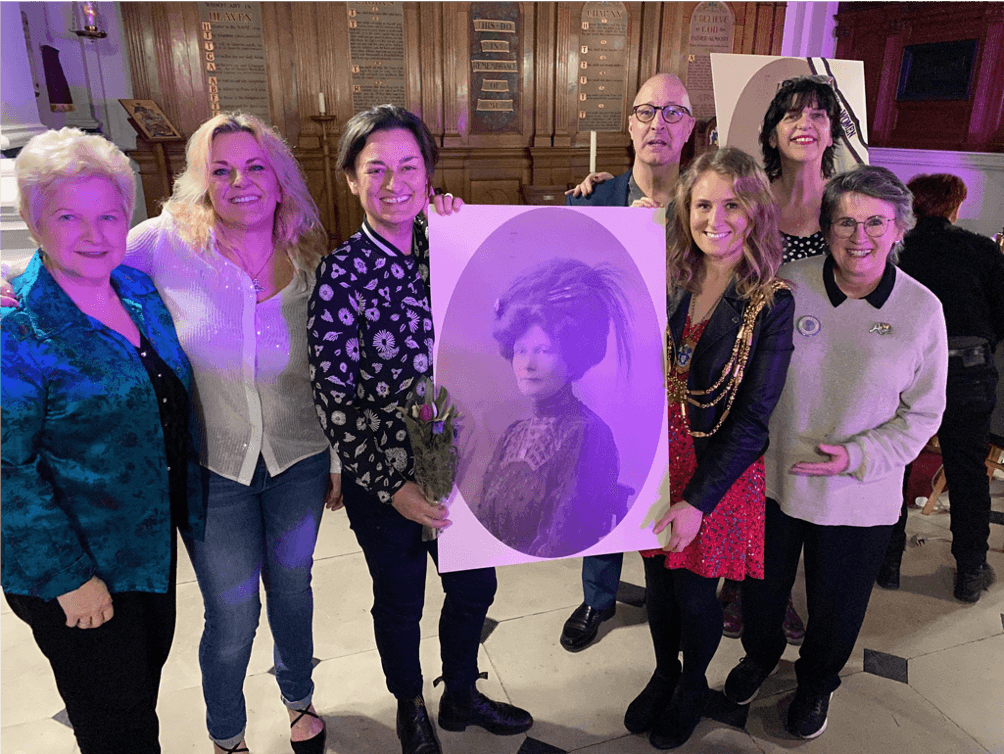
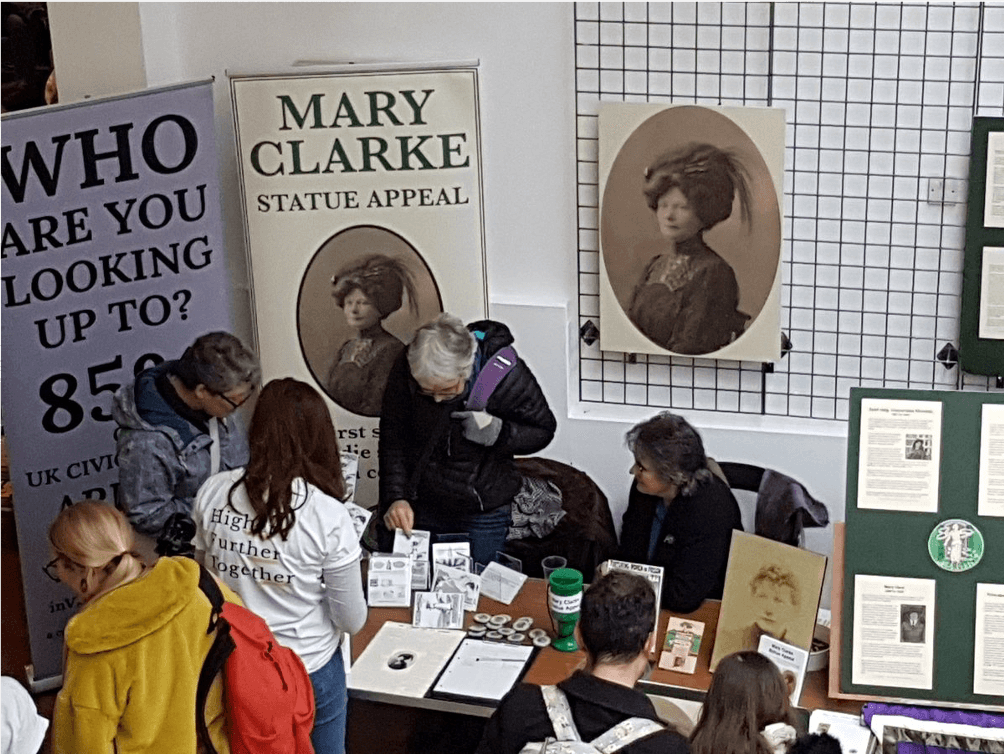
On Saturday 7th March, to celebrate International Women’s Day, the Mary Clarke Statue Appeal set up our stall in the Dome, alongside the Brighton & Hove Women’s History Group and many other women’s and community organisations. We had been invited by Brighton Women’s Centre, both to display our work and also to give a talk about Mary Clarke. This was delivered by Jean Calder, Chair of the Appeal. We were supported by Terri Bell Halliwell of inVISIBLEwomen, an organisation which campaigns nationally for statues of women. The Appeal sold badges (beautifully made by Maria Hogg) and Terri sold her cards, kindly donating all proceeds to the Appeal. Our purpose in being at the event had been to raise awareness rather than money, but to our amazement, we made £104.72. More importantly, we met many people anxious to help and support the campaign. Our thanks to Terri and to Ali Ghanimi of the Women’s Centre, for inviting us and for providing such wonderful support. Also many thanks to the Museum staff for their help, especially on the day.
Elizabeth Crawford
We are thrilled that Elizabeth Crawford, probably the best known British historian of the Suffrage Movement, has agreed to be one of our Patrons. She joins eminent Professor June Purvis, who is an expert on the history of the Pankhursts and wrote acclaimed biographiesof Emmeline and Christabel Pankhurst.
Elizabeth Crawford is an historian and a dealer in books and ephemera by and about women. Her six books include two seminal reference books: The Women’s Suffrage Movement: a reference guide and The Women’s Suffrage Movement in Britain and Ireland: a regional survey. She also wrote Art and Suffrage: a biographical dictionary.
She was awarded an OBE in 2018 for services to education, with special reference to the women’s suffrage movement. She runs a website -womanandhersphere.com.





 Mary wears the Hunger Strikers’ medal and walks across the implements used in forcible feeding, which she ignores and which are imbedded in the surface of the plinth. Her clothing, accurate for the period, subtly references Mary’s background as an artist, her love of flowers and her time in prison. The pattern on the skirt includes the ‘prison arrow’ which was used on convicts’ clothes and was carried with pride on suffragette banners.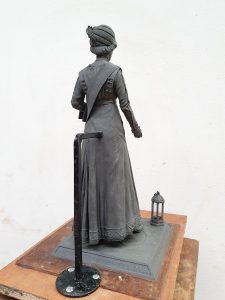


 We are very grateful to local magazines The Post, Preston Pages and 7Directory. They have not only featured long articles about Mary and the Appeal, but have also made the campaign their cover story, using wonderful images of Mary and publicising the fact that the design and rough maquette (model) of the statue-to-be are now complete.
 Supporters living in Brighton & Hove will have noticed that, post lock-down, many of the city’s free community magazines have re-appeared and combined.
 “Mary Clarke is one of the great band of wonderful
 The design is her own, based upon contemporary photographs, but the style echoes the beautiful ‘pennant’ banners carried in procession by the suffragettes. They were designed to represent various women’s crafts and professions, but there were also individual banners to honour individual women of note. A huge amount of work has gone into the banner and despite COVID-related problems in supply of embroidery materials, Jenny is forging ahead. We thought you might like to see her at work. We are so grateful to her for this wonderful gift of her time and creativity. Once completed, the banner will be placed on public display and also taken out on procession. Our hope is that eventually, on key dates such as International Women’s Day or Human Rights Day (which is just before Mary’s birthday) the people of the city will be able to process to the statue with this and other banners.
 On Tuesday 23rd June 2020, on a lovely sunny day as lock-down was just beginning to ease, the new Mayor of Brighton & Hove, Councillor Alan Robins, in full mayoral robes, visited us at the Royal Pavilion Gardens near the entrance to the Museum. He was there to show his support for the proposed statue for Mary Clarke and was accompanied by the Mayoral Consort Val Cawley.
 Our aim is to place Mary’s statue in the Gardens, as close as possible to the entrance to Brighton Museum, where it can be linked to educational displays in the Museum. We hope that every school child, adult resident and visitor will see and recognise the statue as a symbol of the city’s ongoing commitment to democracy, equality and women’s rights.